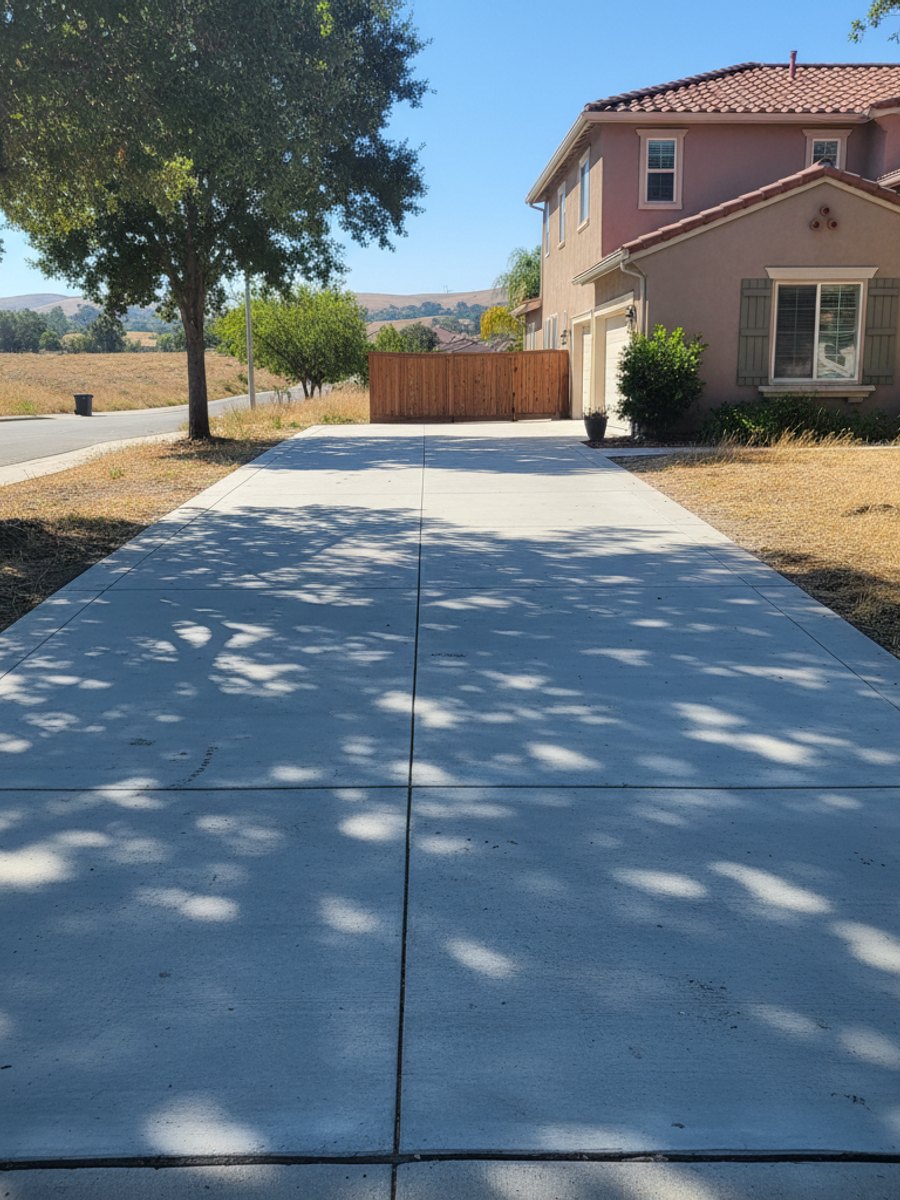
Ask a contractor in Chicago or Denver about the best time to pour concrete and they'll talk about frost lines and freeze-thaw cycles. We don't deal with that here. Los Angeles doesn't really freeze, so the usual rule you'd read on a national home improvement site doesn't apply the same way. What actually matters here is heat, moisture, and how fast the water leaves the mix before the concrete has a chance to cure properly.
Why frost isn't the issue, but evaporation is
Fresh concrete needs water to hydrate the cement for at least the first few days, ideally the first week. In most of the country the risk is the water freezing before that happens. In LA, especially inland, the risk is the opposite: the water evaporates off the surface too fast, before the slab underneath has firmed up. That's called plastic shrinkage cracking, and you'll see it as a web of hairline cracks across the surface within hours of the finish work, sometimes before we've even left the job. Low humidity and wind make it worse. A slab poured at noon in August in the San Fernando Valley, with the air at 98 degrees and bone dry, is at real risk if it isn't cured correctly. The same mix poured at 7am with a marine layer still hanging over Santa Monica behaves completely differently.
The dry season: May through October
Most residential concrete in LA gets poured in this stretch, and for good reason. No rain to worry about, long daylight for the crew, and predictable scheduling. The trade-off is heat management. Once you get past the coastal strip and into the Valley, Santa Clarita, or out toward Palmdale, afternoon temperatures regularly clear 95 degrees from July into September. We pour early, often before 7am, and we either fog the surface, use a curing compound, or lay down wet burlap and plastic sheeting to slow the evaporation rate down to something the concrete can keep up with. Skip that step on a hot day and you're buying yourself a crazed, dusty surface and a callback.
Coastal neighborhoods, Venice, Santa Monica, Marina del Rey, run 10 to 15 degrees cooler on an average summer afternoon because of the marine layer. That's actually a better pour environment than the Valley even in July. Location inside the county changes the calendar more than the actual month does.
The rainy season: November through April
LA doesn't get a lot of rain days overall, but when it comes it tends to arrive as a wet, multi-day system, usually January through March, sometimes bleeding into April. Concrete can't be poured in active rain and it shouldn't be left unprotected for the first 24 to 48 hours after. Rain on a fresh slab before it sets dilutes the surface paste and can wash away the finish entirely. That doesn't mean winter is off the table. We watch the 5-day forecast, not just the day of the pour, and plenty of driveways and patios get poured in December and February without issue. The upside of a cooler, wetter month is that curing is actually easier, less fighting the sun, slower and more even hydration. The slab you pour in February can come out with a better surface than the one you rushed through in a August heat wave.
The one thing winter adds is soil moisture. LA sits on a mix of sandy alluvial soil near the coast and heavier clay inland, and clay-heavy ground in places like parts of the Valley, West Adams, or the foothill communities swells when saturated and shrinks hard when it dries out. Pour a base course on top of waterlogged clay in February and you're compacting soil that's going to change volume again once summer dries it out, which shows up months later as cracking or settling. We'll often wait a few days after a storm for the ground to drain before we bring in base rock, even if the sky has already cleared.
What the ground and the neighborhood add to the timing
Older neighborhoods, Eagle Rock, Highland Park, parts of West Adams, were built mostly from the 1920s through the 1950s, often with sidewalks and driveway aprons poured decades ago over whatever base was standard at the time, sometimes none at all. Mature parkway trees, ficus especially, have pushed roots under a lot of that old flatwork, and removing a tree root before a repour sometimes means waiting on a separate tree permit before we can even touch the concrete. Newer subdivisions out in Santa Clarita, Valencia, or Porter Ranch were built on more uniformly compacted fill and usually come with an HOA that has its own rules on finish color and timing of exterior work, which can add a week or two to a schedule that otherwise has nothing to do with weather at all.
Grading matters year-round but it shows up most in winter. Most LA lots slope toward the street or an alley, and when that grading is off, even slightly, a hard January storm will pool water right where a new patio or driveway meets the house. Part of laying out any new slab is making sure it still sheds water the way the lot is supposed to, not just the way it looks the day we pour it.
Permits don't run on the weather's calendar
Most driveway, patio, and foundation work in the city goes through the LA Department of Building and Safety, and any work in the public right of way, a driveway apron crossing the sidewalk, a new curb cut, goes through the Bureau of Engineering separately. Plan check and permit issuance can take anywhere from a few days to a few weeks depending on the scope and whether an inspector needs to look at setbacks or an existing survey first. That timeline doesn't care if it's July or January, and it's often the real bottleneck, not the weather. If you want a specific pour date in, say, late spring, the permit conversation needs to start well before that.
So what's actually the best month
If you want the simplest answer: late spring, April or May, and early fall, late September into October. The ground has dried out from winter rain, the summer heat hasn't peaked yet, and there's enough runway before the next rainy season for a slab, a wall, or a set of steps to cure out fully. That's a general rule, not a hard one. We pour successfully in August and in January, it just takes different handling each time. If you're planning a driveway, a patio, or a retaining wall and want to talk through timing for your specific property and soil, that's the kind of thing worth a site visit rather than a guess. You can see the range of work we handle through Allied Concrete Solutions.